
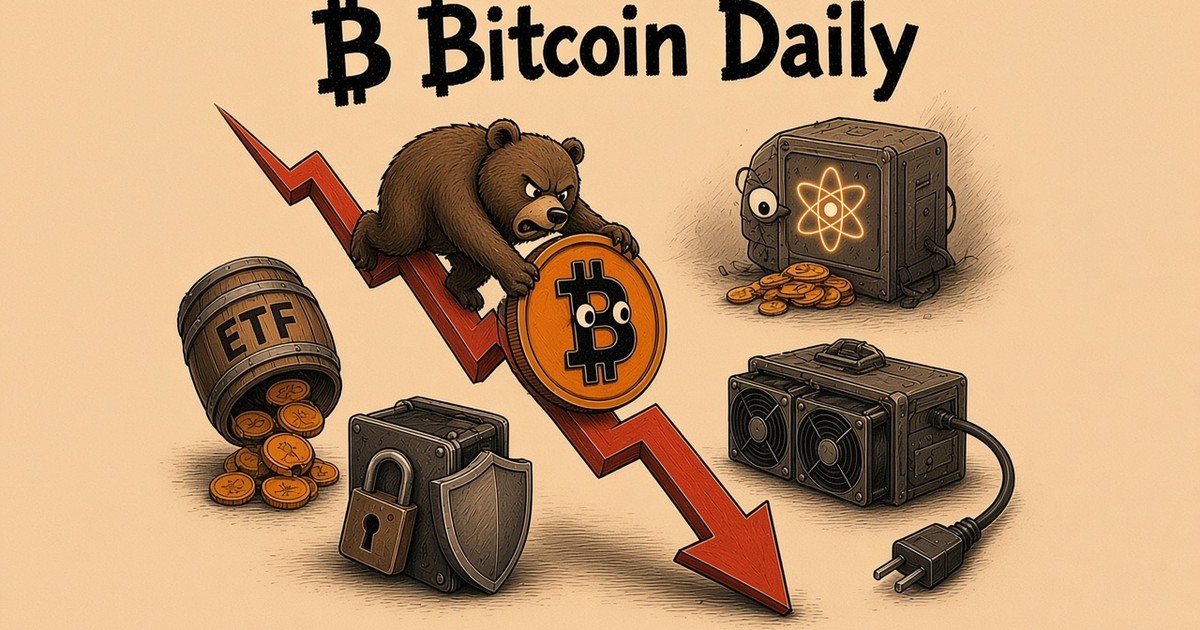

Friday the 13th delivered: overnight Bitcoin fell as low as around $67,500, and on Saturday morning it costs $66,895. This time the blame lies not only with leverage gamblers and a strong dollar, but also with a stock-market listing: investors are apparently selling liquid assets in order to get in on the Anthropic IPO. The US Federal Reserve is openly considering a half-percentage-point rate hike, and the ETFs have been bleeding for six days. And of all people, JPMorgan, whose boss likes to declare Bitcoin worthless, is sitting on just under a billion dollars in Bitcoin-related paper. Anyone who holds Bitcoin because of the 21 million can watch this calmly – and perhaps buy more.
Here is a chart comparison with the 2023 bottom, to cheer you up.

The price: below the $68,000 mark#
Chart-technically it is getting tight. Anal-ysts point to the 200-week average at around $67,975 as immediate support; below that, analysts see the zone from $66,000 to $67,000 and then $62,300. To the upside, reclaiming $75,000 is regarded as the first signal of strength. Bitcoin is thus more than 45 percent below its record of $126,080.
Why it is going down#
The most surprising explanation comes from Seamus Rocca, CEO of Xapo Bank. He sees the Anthropic IPO as the main reason: the subscription books are six times oversubscribed, and the company wants to raise up to $64.4 billion. “When an IPO of this size comes to market, the temptation of a quick return is great, and liquid assets such as Bitcoin are often the first source of cash when investors are fighting for allocations,” Rocca said. Bitcoin as the Wall Street ATM – that is somehow a compliment as well: what gets sold is what can be sold around the clock.
Not everyone shares this view. Mark Connors of Risk Dimensions sees no direct effect from Nvidia, but rather a comprehensive reduction of risk and leverage in the AI trade. Chris Sullivan of Hyperium Decimus points to short positions above the August high and outflows from BlackRock’s IBIT: “If markets were rational, no one would ever make or lose money.”
ETFs are bleeding, Wall Street is buying anyway#
On Thursday a net $284 million flowed out of US spot Bitcoin ETFs, the sixth consecutive day of outflows. Assets under management fell to $89.56 billion; in mid-September they were still over $110 billion. People buy high and sell low – classic pro-cyclical ballet.
A look at the mandatory filings, by contrast, is funny.
JPMorgan: As of September 30 the bank held around $981 million in spot Bitcoin ETFs, Strategy and Coinbase. The largest position is 11.4 million IBIT shares worth about $540 million; the Strategy position grew by 36 percent to 848,932 shares. Banks often hold such positions for hedging or for client business.
All the same: Jamie Dimon has called Bitcoin worthless. His bank now holds just under a billion of it.
Who is staying bullish#
Matt Cole, CEO of Strive, sees parallels to the SpaceX IPO in June: Bitcoin fell 19 percent in the 50 days before it, and now 18 percent ahead of Anthropic. After SpaceX, Bitcoin was up 28 percent on day 100. “If Anthropic follows the same pattern, the bulk of the decline is behind us,” Cole said.
The other side is represented by Peter Schiff, who is calling a long-term bear market. Schiff has been calling that since about 2011.
Germany: tax limbo#
The budget committee has approved the 2027 federal budget: around €561 billion in spending, 6.9 percent more than in 2026, around €123 billion in new debt in the core budget, and with special funds around €210 billion. On the planned Bitcoin tax, including a possible end to the holding period: not a word. A state that is taking on €210 billion in new debt naturally looks with interest at people who put their savings into money that cannot be printed.
What’s ahead#
Over the weekend it will be decided whether Bitcoin writes its sixth red weekly candle in a row; the focus is on the 200-week average around $68,000. The PCE index on November 25 is regarded as an important gauge ahead of the Fed meeting on December 9. At the close of trading on November 30, Strategy is dropped from the MSCI indexes, and in the last week of November the Bundestag will give the budget its final debate. The Anthropic IPO remains the liquidity magnet of the hour.
Tech
Anti-exfil signatures, a STARK proof for the UTXO set and Paraguay’s power poker
While the price is annoying, the developers are delivering. Optech newsletter #431 brings two BIP drafts meant to stop hardware wallets from secretly leaking seeds – exactly the problem the Trezor implants have just held up in front of us. On Delving Bitcoin a developer shows a 1.6-megabyte STARK proof for the complete UTXO set that a browser verifies in half a second. And in Paraguay, AI is pushing miners off the dam socket.
Anti-exfil: the host rolls the dice too#
According to Bitcoin Optech, Connor Avila has presented two BIP drafts on the Bitcoin-Dev mailing list for so-called exfiltration-resistant signing. The problem: the nonce, that is the random number of a signature, is chosen by the signing device. A compromised device could use that to leak the seed bit by bit without the user noticing. Avila’s solution: a two-round protocol in which the host contributes its own randomness and checks whether the device has actually used it – for Schnorr and ECDSA signatures.
The second draft adds three fields per input to PSBTs so that the protocol works in ordinary wallet flows. There are also test vectors, a Python reference and a C module for libsecp256k1. The idea is not new: Stepan Snigirev proposed a standard in 2020, Moonsettler in 2024, and some manufacturers already use the technique. Avila expressly asks for reviews because the cryptography has not yet been audited. After the week of the Trezor implants, this feels as if it were made to order: trust is good, a protocol that makes trust unnecessary is better.
Releases: Lightning is patching#
LDK v0.2.8 and v0.1.14 are security releases against bugs that could lead to loss of funds or DoS; LDK v0.3 is at its fourth release candidate. LND v0.21.8 and v0.20.8 among other things fix problems with AMP recovery and force-closes after static channel backups. Core Lightning now rejects HTLC amounts above 21 million BTC – anyone who wants to send more than will ever exist belongs in a central bank rather than on the Lightning Network.
Mining: Paraguay is turning off the tap#
Paraguay’s state utility ANDE wants all special contracts with miners to expire on December 31, 2027. The miners pay a flat $44 per megawatt-hour and bring the state around $350 million a year; Paraguay accounts for about four percent of global hashrate. ANDE engineers propose a cap of 700 megawatts for mining, AI and data centers combined, auctioned from $56. An AI campus with Founders Fund money has already secured 286 megawatts for 15 years. HIVE has around 77 percent of its capacity in Paraguay. The state as electricity monopolist decides who gets power – the hashrate then simply moves on. It has been doing that since 2009.
Comments
No comments yet. Start the conversation.