


Einundzwanzig.tech
Bitcoin at $64,600: a weekend low, Binance rumors and a Fed that already has the rate hammer in its hand
The weekend brought Bitcoin a four-month low at around $62,000, two billion dollars in forced liquidations and a rumor that Binance was dumping coins onto the market – which CZ promptly denied. On Monday morning Bitcoin again costs around $64,600, almost exactly as much as 24 hours ago. In the options market the largest bet is now a put on $60,000, and the US Treasury Secretary is publicly asking the central bank to please look away when it comes to oil.
The price: a four-month low, then a breather#
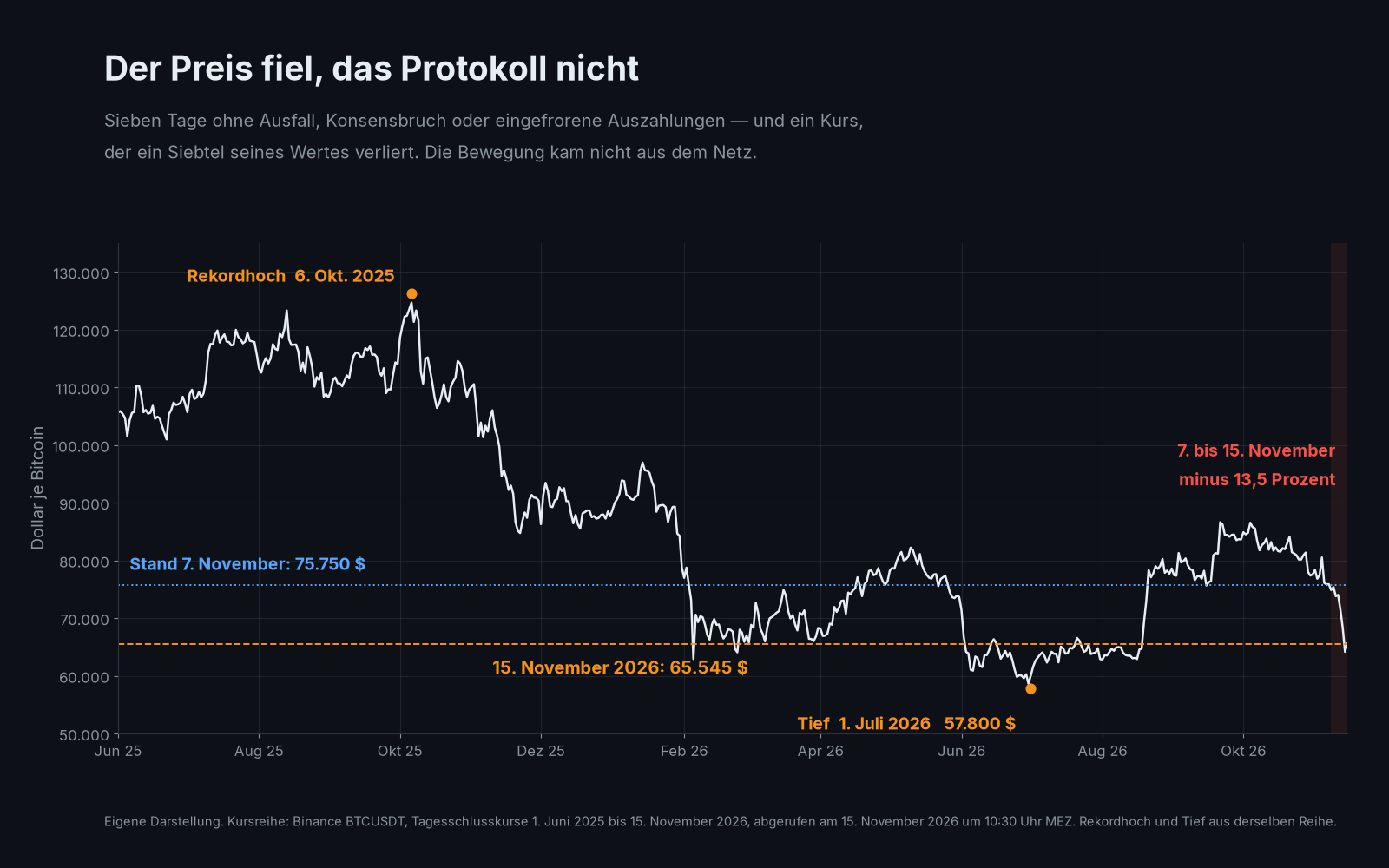
Bitcoin fell over the weekend to around $62,000, the lowest level since July, and recovered by Sunday afternoon (US Eastern Time) to $64,910. On a weekly view the figure is a decline of 14.2 percent.
Two billion dollars of leverage swept away#
Saturday’s crash was above all a leverage slaughter. According to CoinGlass data, between Saturday 8 a.m. and Sunday 8 a.m. (US Eastern Time) positions worth $2.02 billion were force-liquidated, $1.68 billion of that in long positions.
“No, Binance did not sell”#
On Saturday evening the claim circulated on X that Binance had, within 24 hours, sold bitcoin worth $1.767 billion in order to replenish its reserves after the hack of October 29.
Changpeng Zhao contradicted it:
“No, Binance did not sell crypto”, he wrote on X, according to The Block. He had, on the contrary, himself been buying in recent days with freshly received stablecoins.
As possible reasons for the sell-off, CZ named demand around IPOs – keyword Anthropic – fund outflows, security concerns, inflation and politics.
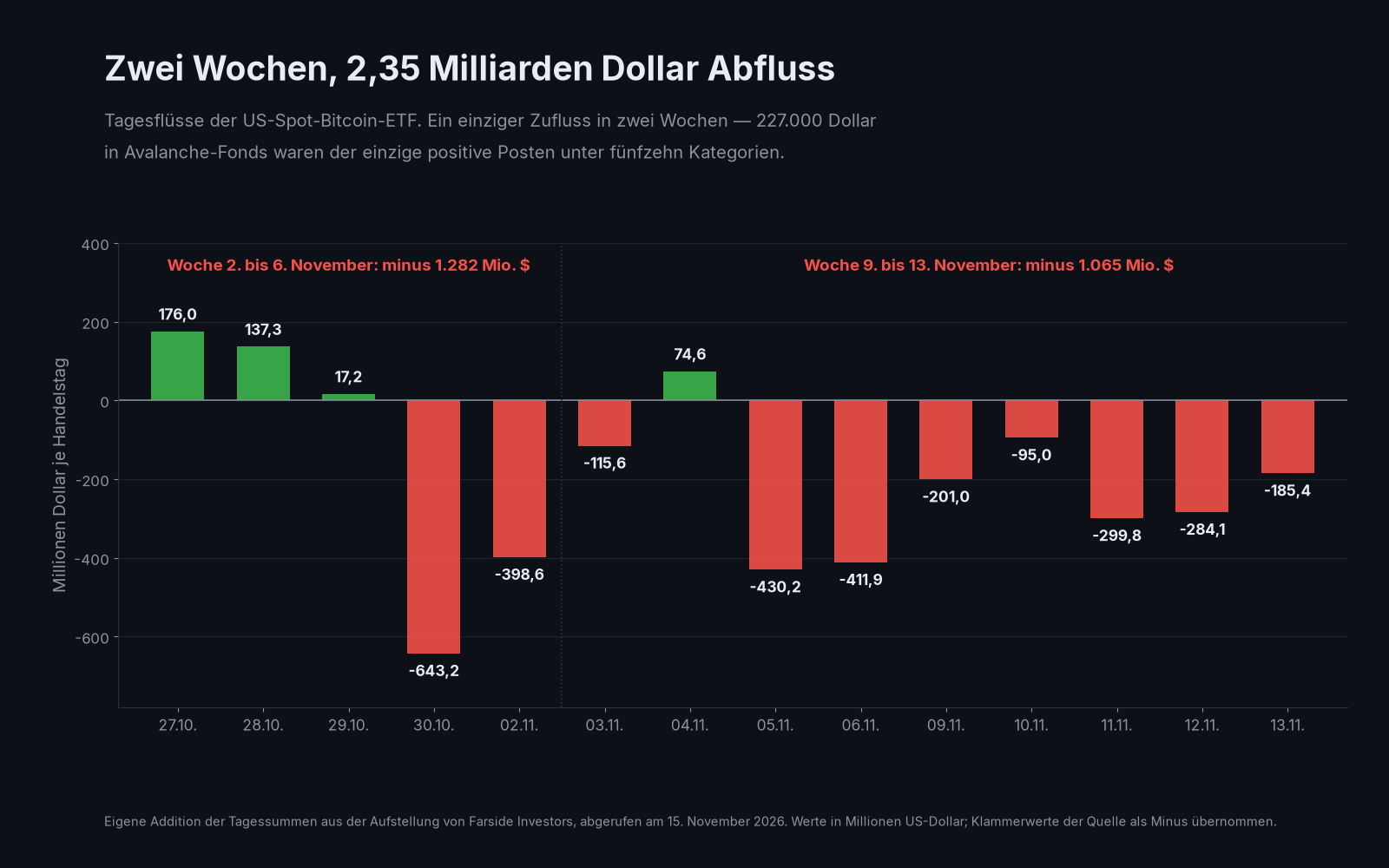
The ETF outflows, at any rate, are real: US spot ETFs lost $2.35 billion in two weeks.
Macro: a strong dollar, a nervous central bank#
The yield on two-year US Treasuries rose by 35 basis points, the largest weekly increase in more than two years; producer prices stood at 6.5 percent year on year. Six and a half percent – so much for the subject of “transitory inflation.”
US Treasury Secretary Scott Bessent, on Fox News, called on the Fed not to overweight oil-driven inflation: “…you look forward, not in the rearview mirror.” That of all people the Treasury Secretary, whose budget lives off low rates, is urging the central bank to be lenient is about as surprising as a debtor who wants cheap credit.
Tech
Hashrate theft by AI: a Luxor attack redirects miners to OCEAN, Silent Payments arrive in Electrum, and RGB learns Lightning#
The technical topic of the weekend is not a soft fork, but remote control: attackers have, through Luxor’s management software Commander, redirected the computing power of mining customers to the OCEAN pool. Early reports spoke of 64,000 devices and 13 exahash per second; Luxor confirms a good dozen affected customer accounts and speaks of an “AI-supported” attack. Alongside that: a new Silent Payments scanner for Electrum that does not tell any server which address one is watching, a Lightning course on the RGB protocol, bitcoin payments via Lightning at McDonald’s in Lugano – and security vulnerabilities at centralized exchanges that once again show where the real risk sits.
Luxor: when the remote control is hijacked#
On Saturday evening (US time) the first warnings hit X. @GalaxyMind reported: “A mass miner hijack is live right now” – since about 8 p.m., around 64,000 miners with about 13 EH/s had been redirected to OCEAN, with payouts to the address bc1qphukp9rjfc4rcej7erpm9ae20xmtspw8pcddrr.
The advice: check pool and wallet settings and change admin passwords.
What miners should learn from this#
The case shows an underestimated attack surface: not the pool, not the firmware, but the convenient cloud-management layer on top. Anyone who steers thousands of machines through a web dashboard places a central remote control for their hashrate in other people’s hands.
Silent Payments for Electrum: scan without snitching#
Silent Payments allow a static, reusable receiving address without every payment being linkable on-chain to that address. Anyone who receives donations or wants to share an address publicly gets privacy without having to send every payer a new address.
Ali Sherief presents spscand, a simple scanner for Silent Payments that works directly with his already published sending plugin for Electrum. The blocks come from one’s own node, from a Blindbit server, or via BIP352 filters.
RGB on Lightning#
With the published video from @BTC_LN you will better understand what the RGB protocol on Lightning is about:
an approach with client-side validation for smart contracts on Bitcoin that keeps data off-chain – for privacy and scalability.
The video is part of a complete Lightning course.
Lightning in everyday life: McDonald’s in Lugano#
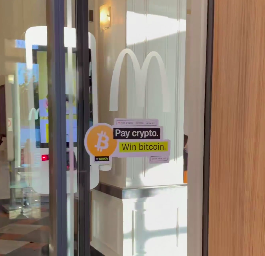
You can now pay at McDonald’s in Lugano with bitcoin over the Lightning Network; @TheBTCoinQueen supplied a complete video of it. Lugano has for years been the laboratory for bitcoin payments in everyday life; now one can pay for bad food with good money :-).
Bitcoin Twitter over the weekend
The Binance rumor: a lot of noise, no source#
The rumors on X appear to be only a lot of noise without any sources at all, but that usually sells very well.
Saifedean versus the degrowth professor#
@fabthefoxx shared on Sunday a clip from the Bitcoin Standard Podcast #351, or rather the Doha Debates: a degrowth professor explains that affordable housing is not being built because it does not pay. Saifedean Ammous asks back how something everyone needs can be unprofitable. Real estate as the nation’s piggy bank.
Lily Allen and the 200,000 bitcoin#
The chuckle of the day came from @LightningNewsX: in 2009 the singer Lily Allen was offered 200,000 bitcoin to play a live concert in Second Life. Her answer: “as if.” At the time the stack was worth a few hundred dollars. Today, even after the weekend slide, at around $64,600 apiece that would be just under $13 billion.



Comments
No comments yet. Start the conversation.