

Bitcoin is going nowhere: on Thursday morning it stands at around $73,600, almost exactly where it stood 24 hours ago. Beneath the calm surface, a lot is being reshuffled. MSCI has definitively dropped Strategy and Metaplanet – anyone with too much hard money on the balance sheet is no longer allowed to play in the major indexes. Analysts at Bitfinex and Glassnode warn of a deeper pullback, while banks in Europe and Israel are discovering that business can be done with Bitcoin after all. For holders in Germany there is good news with a typical Berlin question mark: the planned tax that would have buried the tax-free holding period is, according to BILD, not coming for now. Postponed, as is well known, is not canceled.
The price: sideways below an important level#
Bitcoin is trading on Thursday around 6:10 a.m. (CET) at $73,585, or €66,418. That is −0.1 percent in dollars and +0.6 percent in euros versus the previous day – a slight plus in euros, then, because the dollar weakened. On a weekly view the figure is a decline of a good seven percent, on a yearly view almost 28 percent.
MSCI means business: anyone stacking Bitcoin is out#
The most important news of the day came late Wednesday evening. Index provider MSCI has published its final deletion list for the November review. As Blocktrainer reports, it includes Strategy and Metaplanet, the two largest listed Bitcoin holders. The change takes effect at the market close on November 30. ETFs that track indexes such as the MSCI World, the MSCI USA or the MSCI Japan Small Cap will then have to sell the shares.
This did not come as a surprise. As early as October 2025, MSCI had proposed excluding firms whose balance sheets consist of more than 50 percent Bitcoin and comparable assets.
Banks are expanding anyway#
While the price stagnates, precisely those houses that for years sold Bitcoin to their clients as too risky are moving in. On November 11, Deutsche Bank started custody of Bitcoin – and of Ether and stablecoins as well – for institutional clients in Europe.
The keys then naturally sit with the bank. Israel’s Discount Bank, with $150 billion in total assets, wants to enable retail customers to buy Bitcoin and Ether directly in its app from November 26. And in the quarterly filings, more banks are showing up as ETF holders: Barclays increased its IBIT position by 48 percent to $187 million, and Citigroup newly entered Fidelity’s Bitcoin fund.
Germany: the holding period remains – as long as no one starts thinking about it again#

Frank Schäffler
For holders in Germany, a different report matters more. According to a BILD report, the planned tax on Bitcoin gains is not supposed to come on January 1, 2027.
There is not yet an official confirmation. Former FDP member of parliament Frank Schäffler urged caution:
“This is a postponement, not a cancellation. The draft is still on the table.”
MARA’s first Stratum v2 block, Taproot on a record run and new paths against quantum risks
In tech, the past 24 hours were about what ultimately holds Bitcoin together: who builds the blocks, how one receives, and whether the cryptography will still hold in a few decades. Large miner MARA has found its first block via the more modern Stratum v2 protocol – a small step against censorship at the source. Taproot addresses are reaching a share of almost 30 percent. On the topic of quantum computers, new data show how many bitcoin would theoretically be vulnerable, and first projects are testing quantum-safe signatures.
MARA mines with Stratum v2#
According to the account @btcinsider__, Marathon Digital (MARA) has found its first block via Stratum v2. The account speaks of “a significant expansion of the mining hashrate using SV2”. Stratum v2 is the successor to the old protocol through which mining devices talk to their pool. It encrypts the connection, saves bandwidth and – if the pool supports it – allows miners themselves to decide which transactions go into a block, instead of leaving that choice to the pool. That is exactly where the appeal lies: the less a single operator determines the composition of the blocks, the harder it becomes to filter out transactions because someone does not like them.
That it is precisely one of the largest listed miners taking the step is a signal. Until now, Stratum v2 ran mainly at smaller pools and hobby miners. The more hashrate the protocol uses, the less a phone call to a few pool bosses is enough to make payments disappear.
Taproot approaches 30 percent#
Also via @btcinsider__ came a figure on address formats: over the past 30 days, Taproot addresses accounted for almost 30 percent of all bitcoin received – close to the record for this address type. Taproot was activated in 2021 and among other things brings cheaper and more private multisig solutions. More privacy, lower fees. Five years after activation, there are thus still places where the 2021 update has not arrived.
Quantum: 35 percent visible, first tests underway#
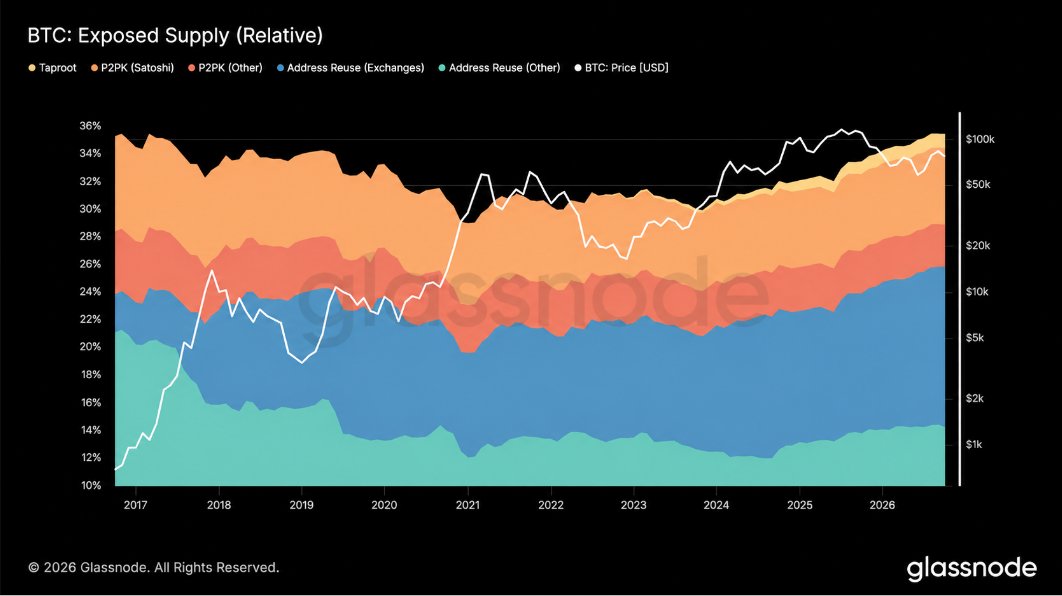
The perennial topic of quantum computers received new data. Glassnode data show that for 35.4 percent of all bitcoin the public key is already visible – mainly through reused addresses (25.8 percent). Such coins would be the first that a sufficiently powerful quantum computer could attack. The simplest protection for users remains the same as always: do not reuse addresses, and hold the keys yourself, instead of waiting for someone else to manage the problem.
Debate and tools#
Worth reading is a guest contribution by Adam Gibson, alias Waxwing, in bitcoin++ Insider, which @btcinsider__ shared and which is also being discussed on Stacker News. Gibson describes two reactions to the standstill in protocol changes: a “reactionary” one that rejects complexity and that for him culminated, for example, in BIP-110, and a “revolutionary” one. His basic thesis: Bitcoin is not a company, but as in a company, entrenched processes become harder to change as it grows. There is no board one could praise, vote out or put under pressure – and that is exactly why Bitcoin cannot be rebuilt by memo.
Comments
No comments yet. Start the conversation.