
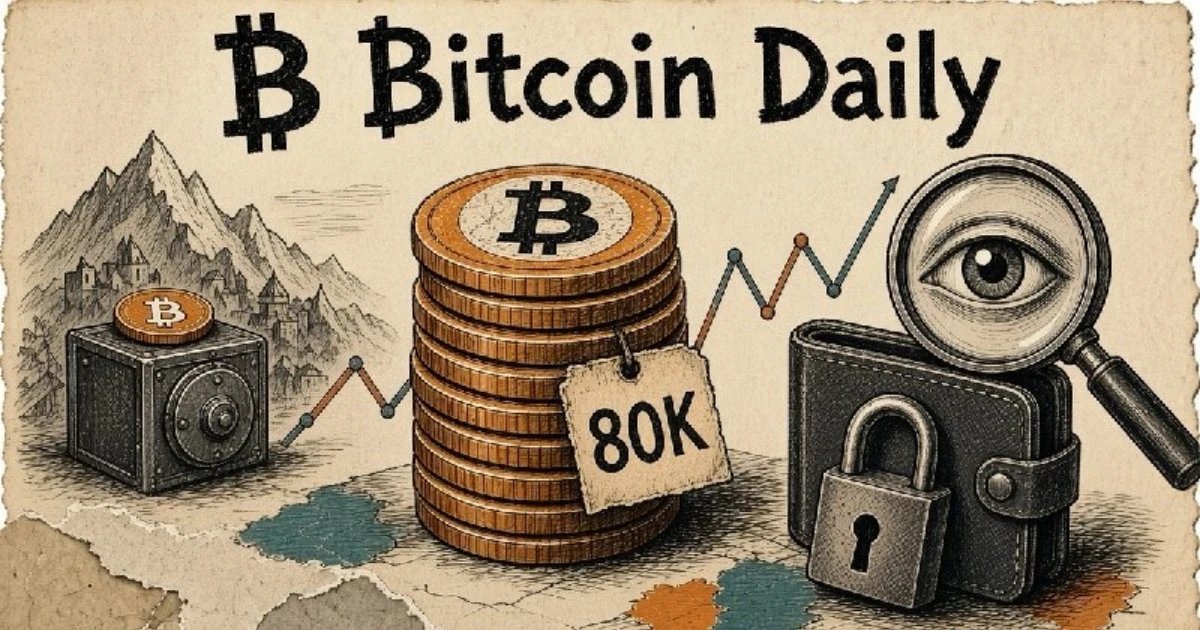

Bitcoin back above $80,000: markets shake off the midterms – and Europe tightens reporting rules
After the midterm low around $75,700, Bitcoin is trading clearly above $80,000 again on Thursday morning. Investors are digesting the Democratic win, a confirmed bank hack, and the question of whether self-custody in France and Austria will soon become a reporting obligation. At the same time, Bhutan is betting on bitcoin as a central-bank reserve – and in Paraguay a banking crisis shows why self-custody matters.
The price: rebound above $80,000#
One bitcoin cost $80,393, or €71,381, on Thursday, November 5, 2026, around 06:09 (CET). That is a gain of about 4.1 percent in dollars and 3.8 percent in euros versus the previous day. Only one night earlier, the price had fallen to about $75,700 in the midterm low.
Bitcoin has risen back above $80,000 after the Democrats’ election win in both chambers of Congress. Markets appear to have already priced in a political gridlock. Short positions on the order of around one billion dollars were liquidated, according to industry headlines, as the price reclaimed the round number.
“There are no sellers left in crypto”
That also fits the news that Strategy preferred shares STRC have risen back to $100 for the first time since mid-May – the level at which new issuances and thus fresh buying power for bitcoin purchases become more attractive again.
Europe: self-custody under watch#
France’s National Assembly passed an amendment on November 3 by 150 to 44 votes (8 abstentions): self-custodied crypto wallets with a total value from €100,000 are to be reported to the tax authorities. Anyone who fails to report risks a fine of up to €10,000. The rule is part of the 2027 budget draft – or maybe not.
Because just one day later, the National Assembly rejected the entire revenue section of the 2027 budget draft, which also dropped the reporting obligation from the draft again.
You should be careful with such reports; often they are mainly meant to grab attention.
In Germany, Max Lucks of the Greens is calling for a cut in the top tax rate on bitcoin speculation from currently 42% to 25%. In return, the tax for small savers is supposed to rise to 26.5%. Which also makes sense when you consider who votes for the Greens – usually not the small savers.
Bhutan and Paraguay: two sides of the same coin#
One kingdom is taking a different path: here a central bank is expressly allowed to invest in bitcoin. Quite the opposite in Paraguay: Ueno Bank is under receivership, millions of customers are locked out, and the crisis is spreading. In Paraguay, cash is still king, and a solid 40% of residents have no bank account at all.
For bitcoiners the lesson is old and current: a bank account is a promise from the bank – a UTXO on your own wallet is ownership on the network.
Conclusion#
Bitcoin above $80,000 after an election night that briefly pulled stock futures and crypto down together is a strong signal. At the same time, France’s reporting rule, Paraguay’s banking chaos and Bhutan’s reserve decree remind us that bitcoin’s real advantage is not the daily price, but the ability to hold wealth without permission.
Tech
Great Consensus Cleanup: what is moving Bitcoin tech this week#
Matt Corallo gives the “Great Consensus Cleanup” around an 80 percent chance as the next soft fork – more cleanup than revolution. Coinbase stresses 99 percent offline custody, and Spiral asks what comes next after storing value.
BIP-54: soft fork as a practice run#
According to Decrypt, long-time Bitcoin developer and BIP-54 co-author Matt Corallo sees about an 80 percent chance that the “Great Consensus Cleanup” – first proposed in 2019 – will be Bitcoin’s next soft fork. It covers four leftovers where developers largely agree: poison blocks, time-warp bugs, Merkle malleability and duplicate coinbase transactions. None of that is acutely catastrophic, but all of it is real.
Paul Sztorc of LayerTwo Labs calls a possible activation
“kind of depressing, since it is a janitorial maintenance fork that doesn't do anything”
Janitorial work instead of a feature. Exactly that, for Corallo and others, is the point: the community practices the activation playbook again before larger changes arrive. The earliest estimates are September 2027; most voices say 2028 or later.
Coinbase after the Binance hack#
After the $6.4 billion hack at Binance, Coinbase stresses according to Decrypt that more than 99 percent of customer assets sit offline in cold storage. On top come split keys, withdrawal limits, anomaly detection and kill switches that can take signing keys offline. Customer funds are held 1:1.
Conclusion#
The tech news complement each other: the base protocol cleans up leftovers and practices upgrades, wallets become threshold-capable and more private, exchanges stress cold storage.
Varoufakis/DiEM25#
The stone-age socialist and bitcoin critic Varoufakis is begging for money on X because their accounts were frozen. If only there were a network for that … Well, if he weren’t such an idiot, he wouldn’t be a socialist either.


Comments
No comments yet. Start the conversation.