
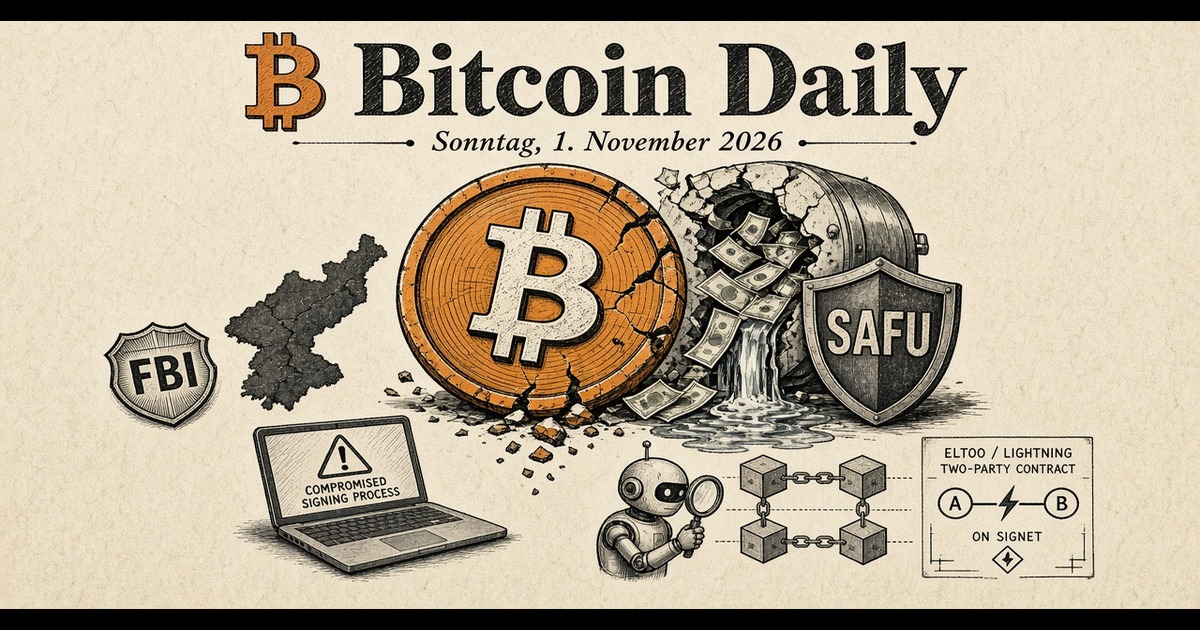

Bitcoin stabilizes at $77,700 – Binance reports 90 percent restored, FBI names North Korea
Three days after the biggest crypto hack in history, the market is calming down: Bitcoin is trading at around US$77,700 on Sunday morning, Binance plans to reopen withdrawals today, and the FBI has officially named North Korea as the perpetrator.
The price: slight recovery after the shock#
On Sunday, 1 November 2026, at 06:04 CET, one Bitcoin cost US$77,737, or €69,411. That is a gain of about 0.8 percent compared with the previous day. Market capitalization stands at roughly $1.56 trillion, and trading volume over the last 24 hours at around $45 billion. Weekend trading was therefore calm: after Friday's slump, the price has settled just below the $78,000 mark. Given the scale of the Binance incident, the reaction has been comparatively mild.
The reasons: Binance pays, North Korea did it#
The most important factor behind the calm is Binance's pledge to bear the damage entirely itself. By its own account, the exchange has now recovered 90 percent of the stolen assets -up from 80 percent the day before.
The remainder consists mainly of less liquid tokens, which Binance is buying back on the market and over the counter. This is financed from the company treasury, part of the SAFU emergency fund and part of the futures insurance fund. Withdrawals are due to restart today, Sunday.
In parallel, the question of who did it has officially been settled. On 31 October, the FBI confirmed that North Korea is responsible for the theft of more than $6 billion.
According to the FBI, the attackers have already swapped stolen assets into Ether. According to Glassnode, at around $6.3 billion the Binance hack is larger than the next nine biggest crypto hacks combined. The previous record was the Bybit exploit at $1.5 billion.
"I've always felt it was a little bit dangerous. But no, they say they have it pretty much under control. We'll see." - Donald Trump
"Binance has committed its own balance sheet to making customers whole. I expect it to deliver. Our industry will learn from this incident, strengthen security, and emerge stronger and more resilient." - Michael Saylor
"I do have conviction that over any reasonable time frame, this does not change the investment thesis on Bitcoin." - Matt Cole, CEO of Strive
On X, on-chain analyst @therationalroot summed up the situation in one sentence: "Reset to the STH Cost Basis." Bitcoin has thus fallen back to the average cost basis of short-term holders - a level that, in his analysis, serves as a litmus test for momentum.
Technology#
Signing process instead of keys: what the Binance hack teaches technically - plus Eltoo with TEMPLATEHASH on Signet#
The weekend was technically all about security: new details on the Binance attack show that it was not private keys but the signing process that was the entry point. At the same time, there were AI-assisted attacks on Chainalysis, and on Delving Bitcoin an exciting experiment on covenants.
Binance: the attack on the signing process#
The more details emerge about the record hack, the clearer it becomes: the attackers did not have to steal wallet keys. According to Blockaid CEO Ido Ben-Natan, the perpetrators apparently compromised Binance's transaction signing process. Binance itself said it has no indication that private keys were leaked, but the investigation is still ongoing.
Cryptography is only as strong as the processes around it. If an attacker controls the software that decides what gets signed, even securely stored keys won't help.
Chainalysis: attack with AI agents#
This news will surely please some in the community :-).
The attackers gained access to internal Chainalysis systems and captured customer data: usernames, email addresses, user IDs and details about roles within organizations. According to the company, "offensive agentic techniques" were used, i.e. AI-assisted attack methods.
For Bitcoiners, this mainly means: with leaked names and email addresses, the risk of targeted phishing emails rises.
Delving Bitcoin: Eltoo with TEMPLATEHASH#
Developers are currently building new ways on the Bitcoin test network for two people to pay each other without anyone being able to "roll back" an old intermediate state.
Imagine a shared pot (a channel): Alice and Bob pay in and keep a kind of ledger. With classic Lightning channels, old intermediate states have to be punished harshly, otherwise someone could slip in an older, more favorable state. With Eltoo, this is supposed to become simpler: whoever has a newer state simply replaces the old one - no drama.
This is exactly what Aaron Zhang tried out. He built the same small practice channel three times, each time with new building blocks that Bitcoin is currently testing. The main novelty is a tool called OP_TEMPLATEHASH: it puts a fingerprint of the planned payment on the table, so that another building block (CSFS) can react to it. This makes the "update" script tiny - in the test only about 10 bytes instead of long, complicated scripts. The settlement script (the final accounting) came to about 35 bytes.
The advantage: channels could become lighter and cheaper, and outdated states no longer need to be prevented with harsh penalties. That makes Lightning-like payment channels more robust and easier to understand. Zhang himself stresses that his example is a toy (one key, no real HTLCs) - but as proof that the idea works, it counts in the developer debate.
Whitepaper archaeology#
For the whitepaper's 18th birthday, a post on Stacker News recalls that Satoshi revised the document twice after the announcement of 31 October 2008. In total, four versions are known, including a copy preserved by Nicholas Bohm. The file hosted today at bitcoin.org/bitcoin.pdf carries a creation date of 24 March 2009 according to its metadata.
18 years of the whitepaper: the community celebrates - and discusses security, cycles and self-custody#
Bitcoin turned 18 and is finally allowed to drive a car on its own.
Back to Satoshi's words#
On 31 October 2008, Satoshi Nakamoto published the Bitcoin whitepaper.
Two months before publication, Satoshi reportedly asked Adam Back by email how to cite Hashcash. Bitcoin builds on its proof-of-work,
"so no one has to be in charge"
Conclusion#
On its 18th birthday, the community appears resilient. The biggest exchange hack in history is not read as a weakness of Bitcoin, but as confirmation of an old lesson: central custodians are targets. The answer that is already in the whitepaper's title is peer-to-peer - with your own keys.
Comments0
No comments yet. Start the conversation.